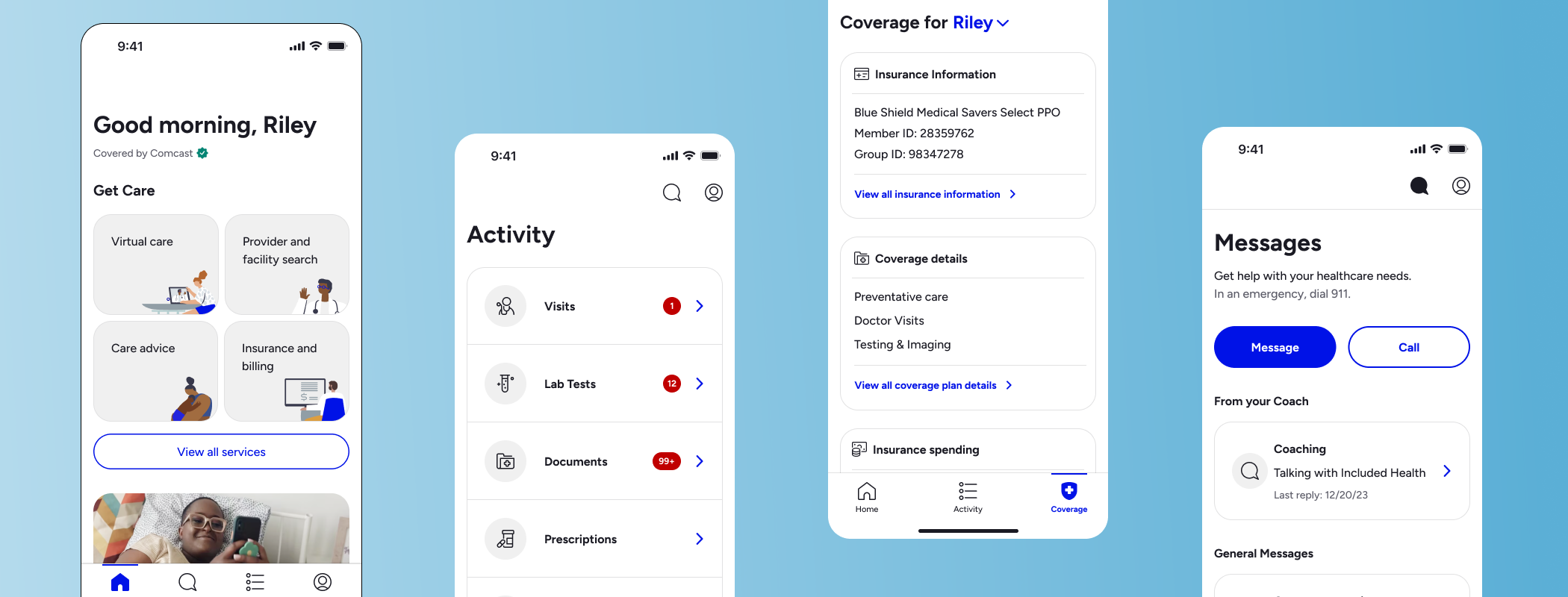
Included Health was operating two separate apps: Doctor on Demand and Grand Rounds. Members were navigating between them. Engineers were making simple front-end changes that took weeks. Data was siloed in ways that blocked business development. The decision to re-platform was the right call. But combining two full products into one, across 250 people in engineering, product, design, and data, without a shared design direction would have just moved the mess into a single place.
That's where I came in.
What I did
Fifteen teams were spinning up simultaneously, each scoping their piece of the new app in isolation and carrying over legacy IA patterns from whichever app they knew best. Before production work started, I needed the entire design organization looking at the same picture. I moved fast.
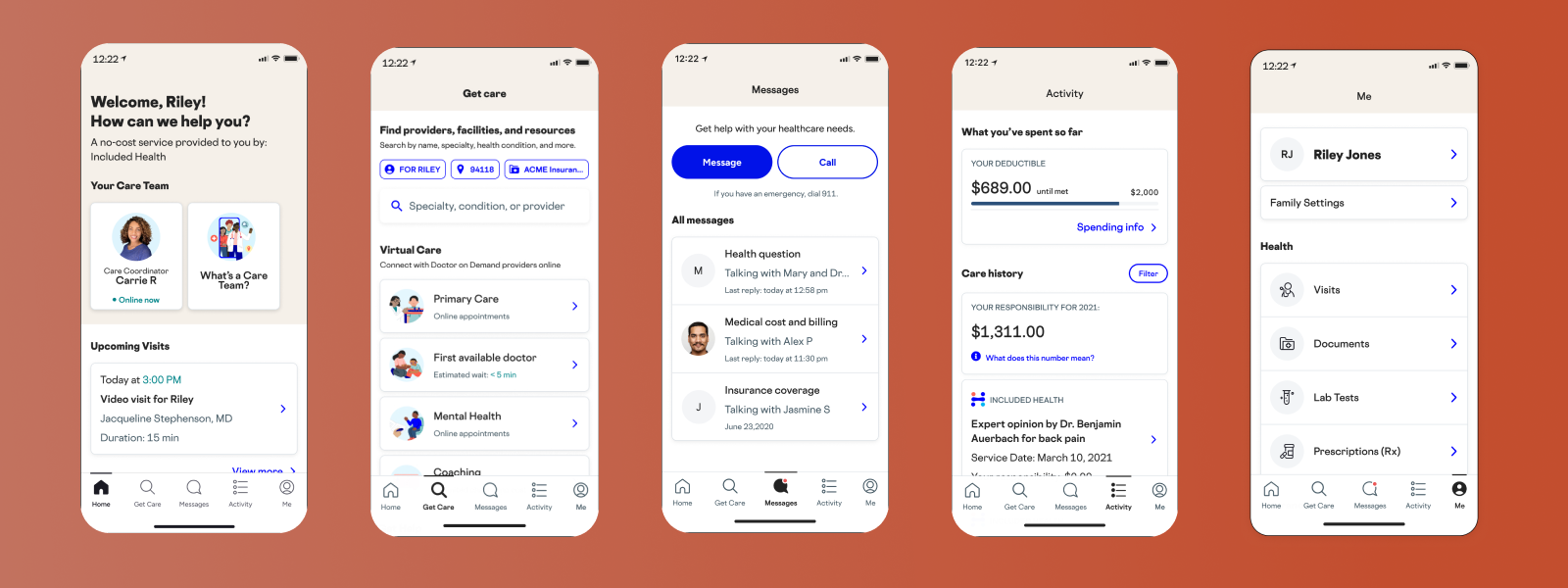
I led the team through a sequenced foundation: object modeling first, then gray box flows, then a low-fidelity map of the entire app experience. That full-app map became the connective tissue for everything that followed. We used it to divide work clearly across 15+ designers, to get engineering started with confidence, and to shape the PRDs each product manager was writing in parallel. The investment up front meant every team knew what they owned and how their piece connected to the whole.
From there, my job shifted to keeping it coherent as the work scaled. I stayed close to what each team was building, regularly pulling people back together at the seams where the experience had to feel unified — handoffs between navigation and care delivery, moments where a member moves between a clinical interaction and an administrative one. The places that look fine in isolation and break in real life.
I also introduced milestone-based member testing at every major stage gate, not just at launch, keeping us connected to real users throughout the nine-month build and giving us early signal on risks before they became expensive to fix.
Fifteen teams building in isolation is fifteen different products. My job was to make sure we shipped one.
Emily Schmittler
Early alignment artifact — the full-app low-fidelity map used to coordinate 15+ designers, define ownership boundaries, and kick off engineering with confidence. Interact to explore the milestone-by-milestone progression.
Leading beyond design
The thing I'm most proud of on this project wasn't a design deliverable.
Included Health had never done live, end-to-end product demos at milestone stage gates before. Teams were operating in deep silos, and there was no forcing function to prove the product actually worked across the seams. I saw the risk and built one.
I designed end-to-end member and clinician stories that spanned every team's work, then coordinated across all of them to ensure the product could demonstrate those stories live at each milestone — not slides, not prototypes, working software. If a handoff was broken or a key capability wasn't present at a critical moment, it showed up in the demo and got fixed before it compounded into something worse.
The effect was real. Teams that had been building in isolation had a shared moment of accountability at every stage gate. Problems that would have surfaced at launch surfaced months earlier. We launched on time. Without that structure, we would have been at least three months late.
What we caught at launch
At launch, I coordinated intensive live user testing throughout the first week — multiple sessions per day — specifically to catch issues before they hit the broader member population.
On day one, we identified a waiting room problem that was suppressing visit volume below expectations. Because we caught it immediately, I brought the issue to engineering with a clear design solution the same day. We were back on track within days. That recovery happened because the testing infrastructure was already in place and the cross-functional coordination was already practiced. We were built to move fast when it mattered.
Day 1 fix
Waiting room — identified and resolved within 24 hours of launch
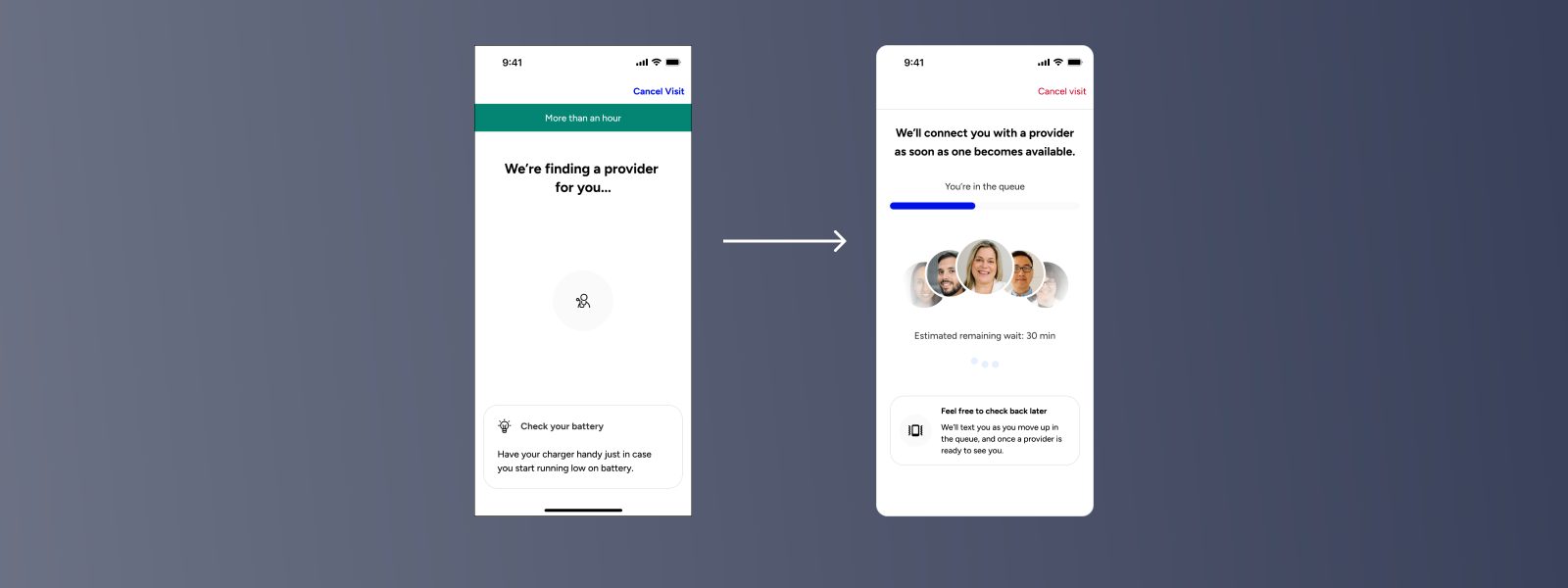
The waiting room problem caught on day one — the old screen gave members no feedback on wait time or queue status. The fix surfaced estimated wait, queue position, and real provider photos, recovering visit volume within days.
What this unlocked
Beyond the metrics, this project changed how the organization thinks about design's role in large-scale engineering efforts. The early alignment work — object modeling, gray box flows, the full-app map — became a model for how design can set up an entire cross-functional org for success, not just deliver screens at the end. And the milestone demo structure raised the bar for what "ready" means across product and engineering in a way that outlasted the project itself.
Re-platforming is rarely glamorous work. But done right, it's the kind of foundational effort that makes everything after it faster, cleaner, and better for the people who actually use the product. That's what energizes me about this kind of challenge.
Interested in the full case study? I'm happy to walk through the strategy, the design decisions, and the team dynamics in depth.